




Peer Review
Publication of articles in Damhil Law Journal (DLJ) is dependent solely on scientific validity and coherence as judged by our editors and/or peer reviewers, who will also assess whether the writing is comprehensible and whether the work represents a useful contribution to the field. Damhil Law Journal (DLJ) acknowledged the effort and suggestions made by its reviewers.
Initial Evaluation of Manuscripts
The Editor will first evaluate all manuscripts submitted. Although rare, yet it is entirely feasible for an exceptional manuscript to be accepted at this stage. Those rejected at this stage are insufficiently original, have serious scientific flaws, or are outside the aims and scope of the Damhil Law Journal (DLJ). Those that meet the minimum criteria are passed on to experts for review.
Type of Peer Review
Submitted manuscripts will generally be reviewed by two to three experts who will be asked to evaluate whether the manuscript is scientifically sound and coherent, whether it duplicates the already published works, and whether or not the manuscript is sufficiently clear for publication. The method is double blind peer review.
Decision
Reviewers advise the editor, who is responsible for the final decision to accept or reject the article. The Editors will reach a decision based on these reports and, where necessary, they will consult with members of the Editorial Board. Editor’s decision is final.
Review Process
Detailed information about the flow of the manuscript submission to the acceptance by the editor is shown in the following figure:
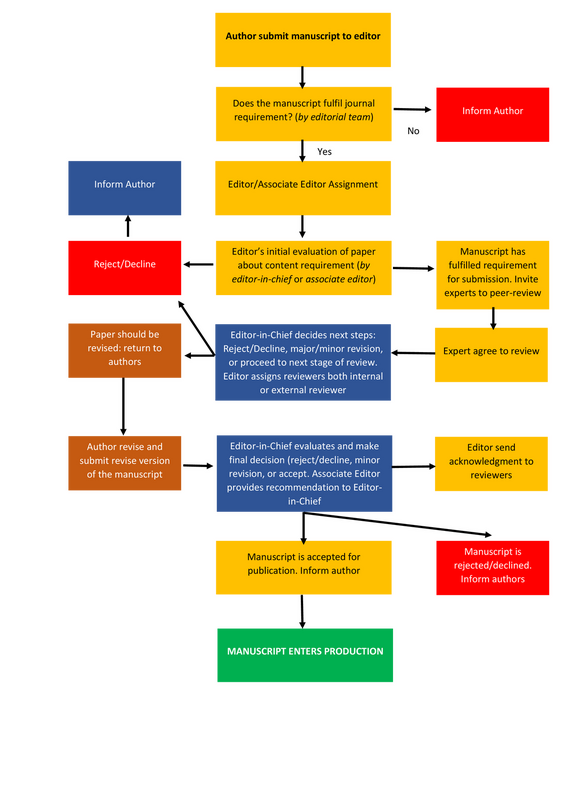
The final decision of manuscript acceptance is made by Editor in Chief (together with Editorial Board if required) according to reviewers' critical comments. Jurnal Legalitas has five types of decisions:
- Accepted. The journal will publish the paper in its original form;
- Accepted by Minor Revisions, the journal will publish the paper and asks the author to make small corrections (let authors revise with stipulated time);
- Accepted by Major Revisions, the journal will publish the paper provided the authors make the changes suggested by the reviewers and/or editors (let authors revised with stipulated time);
- Resubmit (conditional rejection), the journal is willing to reconsider the paper in another round of decision-making after the authors make major changes;
- Rejected / Decline (outright rejection), the journal will not publish the paper or reconsider it even if the authors make major revisions. Generally, on grounds of the outside of focus and scope, major technical description problems, lack of clarity of presentation.
Editorial Office Damhil Law Journal |
 | Postgraduate Program, Master of Laws, Universitas Negeri Gorontalo Jend. Sudirman street No.6, Post Code 96120, Gorontalo, Indonesia |
 | E-mail: dlj@ung.ac.id |
 | +62 851 5675 3187 (Call/SMS/WA) |
 | Damhil Law Journal (e-ISSN: 2808-7143) is licensed under a Creative Commons Attribution-NonCommercial 4.0 International License. Powered by Public Knowledge Project OJS. |